

Future-Proofing Your APIs for Agents Makes Developer Experience Effortless—and Integration Cheaper
Agent‑readiness isn't a distraction from developer experience. It is the most pragmatic way to improve it.

In my free time I like to play with APIs and build small projects to feed my curiosity. Also a classically trained artist, I love to communicate my ideas visually sometimes on a canvas and sometimes through a flow chart.
This post was originally posted on my Substack
APIs easy for agents are easier for humans. Optimizing for agent consumption means developers can build, ship, and trust APIs faster.
The Forcing Function effect
Designing for agents is a productive constraint that benefits developer directly. It forces:
Clarity: APIs with clear contracts, predictable errors, and simple branching empower both agents and developers.
Intent-Driven Endpoints: High-level, opinionated operations minimize glue code and integration effort.
Predictability: Features like idempotency, reliable webhooks, and stable recovery paths make automation straightforward and releases smoother.
Clear Information Architecture: Well-chosen names and resources map directly to user intent, reducing confusion.
Minimal Surface Complexity: Push most edge cases and intricate logic behind robust, stable workflows.
Safe Transactions: Built-in idempotency and compensating actions ensure reliable, error-resistant operations.
Observability by Default: Correlation IDs, detailed event logs, and end-to-end traceability make monitoring and debugging simple.
Fast Time to Value: Rapid “time to first transaction” accelerates positive outcomes for developers and agents alike.
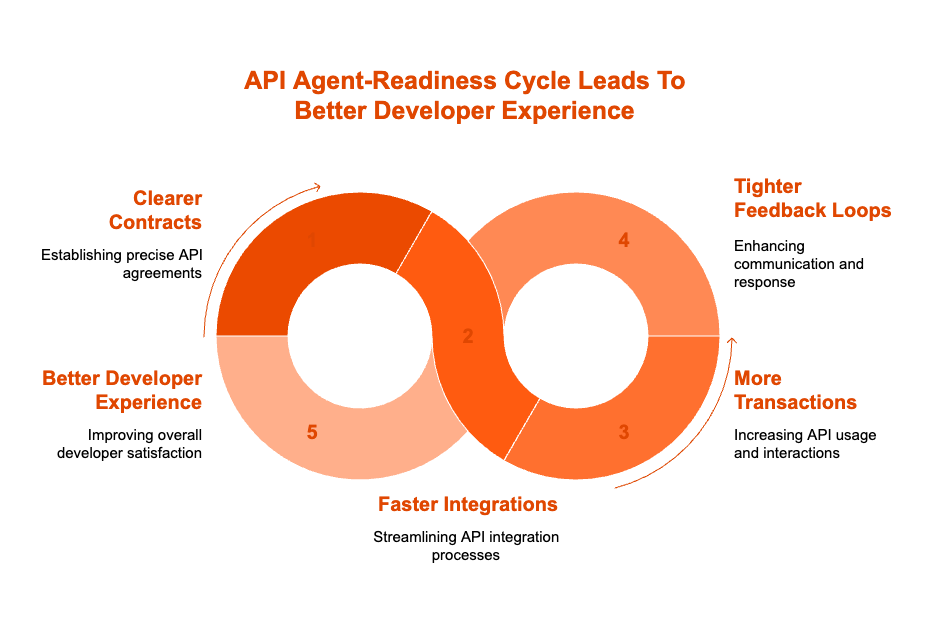
The result is a virtuous cycle: clearer contracts → faster integrations → more transactions → tighter feedback loops → even better DX.
What to ship next if you lead an API product
Hosted “happy path” flows
Example: a single Create‑Checkout endpoint that handles validation, capture, and post‑transaction events.
Provide copy‑paste curl and a runnable Postman collection. Add a one‑click sandbox run.
Machine‑legible docs
OpenAPI + JSON Schema with canonical examples. Keep reference short and precise; move narrative to guides.
Publish error catalogs with remediation steps. Include retry‑ability and idempotency notes.
Outcome‑centric pricing
- Align price to business events, not raw calls. Publish clear ceilings and tiers to preserve margins.
Guardrails and trust
- Idempotency, fraud checks, velocity limits, and reversible operations. Document failure modes and recovery.
Instrumentation for TTFT (Time-to-first-transaction)
- Track time from first authenticated call to first successful transaction. Use it as a north‑star KPI.
Developers get a free upgrade
When you invest in making your APIs, Agent-ready, or AI-ready, you are inadvertently investing in developer experience. Developer isn’t being ignored. Developers are getting the upgrade they always wanted. And this should show in all your existing Developer Experience metrics.
Every upgrade you make for agents feeds the virtuous cycle—making things easier, faster, and better for real people building with your APIs.
If you’re interested in actionable metrics and practical frameworks for API measurement, my book ‘API Analytics for Product Managers’ goes deeper into these topics.