
From First Call to First Transaction: How AI Compresses API Time-to-Value
AI Makes APIs Pay—By Eliminating Friction.

In my free time I like to play with APIs and build small projects to feed my curiosity. Also a classically trained artist, I love to communicate my ideas visually sometimes on a canvas and sometimes through a flow chart.
This post was originally published on my Substack.
With AI as your customer, APIs deliver value at the speed they were always meant to. Optimize for time to first transaction, and you build the platform giants of tomorrow.
The shift from TTFC to TTFT
Time to First Call (TTFC) is a developer‑relations milestone. It proves someone said “hello.”
In plain English: TTFC means a developer has successfully set up your API and made their very first request—it’s like saying “hello” to your system.Time to First Transaction (TTFT) is a business milestone. It proves value flowed.
In plain English: TTFT is the moment a real transaction happens, like a payment or a data exchange, showing that your API is actually generating business, not just being tested or explored.
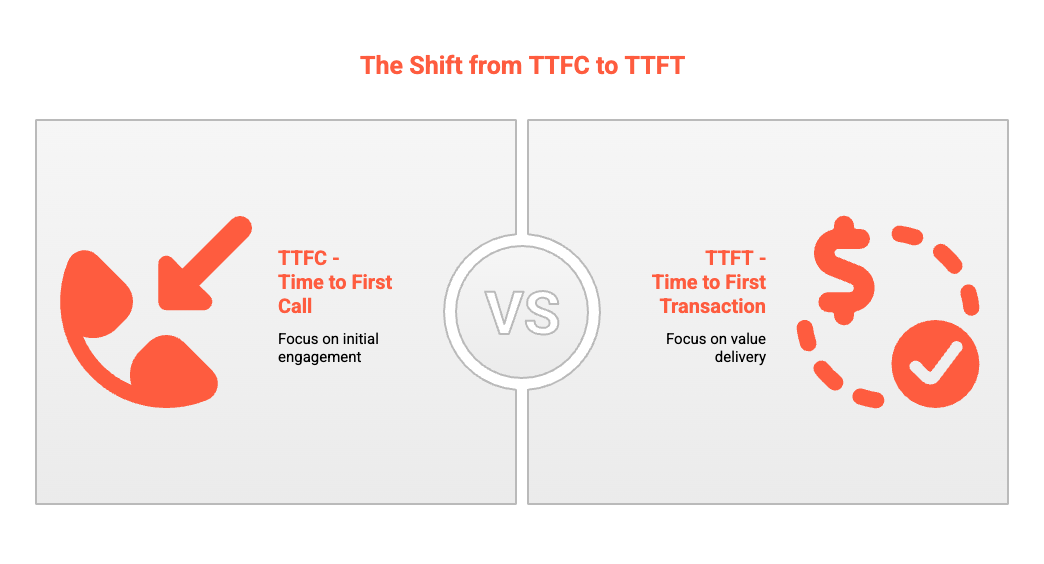
When AI and agents become your primary consumers, TTFT becomes the north star. It changes how you design, price, and distribute APIs.
How AI Shortens the Path from Hello to Transaction
The difference between traditional and agentic journeys becomes clear when you visualize the steps involved. Rather than navigating a maze of manual integration, orchestration, and testing, AI-driven approaches take a direct route from intent to transaction. The following diagram illustrates how much shorter and more streamlined the path has become.

Removes human latency between integration and impact
- Agents do not wait on sprint cycles or cross‑team handoffs. They can evaluate, integrate, and transact immediately.
Orchestrates across providers
- Real outcomes almost always require multi‑API workflows. Agents plan, call, and reconcile across services without manual glue.
Surfaces intent, not just syntax
- Natural‑language goals compile into API calls. Clear schemas and examples let LLMs select and chain the right endpoints.
The result isn’t “smarter APIs.” It’s faster value flow through the same pipes. Monetization accelerates when the path from intent to completed transaction shrinks.
Concrete examples of acceleration
PayPal: TTFC is the auth call. TTFT is the first real payment processed. Historically, the integration steps in between were the bottleneck. Agents compress that overhead to near‑zero.
Stripe Instant Checkout + ChatGPT: Embedding a pre‑built payment flow that an agent can invoke collapses TTFT from days to seconds. That’s not just better DX—it’s monetization acceleration.
Designing for TTFT: a practical checklist
Shorten the path to value
Ship hosted, opinionated flows for the top 3 jobs‑to‑be‑done.
Provide a single “perform transaction” endpoint with idempotency and webhooks.
Be legible to LLMs
Keep specs small and exact. Include runnable examples and canonical error patterns.
Document preconditions and side effects explicitly. Ambiguity kills agent reliability.
Price for outcomes
- Align billing with the business event. Offer clear tiers that map to transaction volume and value.
Prove trust fast
Seed sandbox with realistic, diverse sample transactions so agents can simulate—‘test like live’
Make rollback paths obvious. Agents should be able to attempt, detect, and revert safely.
The platform shift: from dev‑tools to revenue rails
In the last platform wave, dev‑tools companies won by maximizing adoption. In the agent wave, revenue rails will win by minimizing TTFT. If an agent can take a user’s intent and reach a completed transaction in one or two calls, your API becomes a default building block in thousands of autonomous workflows. The compounding effect is twofold:
More transactions per unit time because orchestration is automated
Higher attach of adjacent monetizable events because the path is short and reliable
What “good” looks like, end‑to‑end
Real-time analytics now show which capabilities lead to completed transactions, where agents drop off in the flow, and the revenue impact of each event—helping you attribute each dollar earned to specific customer intents.
A buyer states an outcome in natural language: “Charge $20 for the new add‑on.”
The agent selects the right capability from a concise, deterministic spec.
It executes the hosted flow, receives a webhook, and writes an idempotent, auditable ledger entry.
Pricing maps to the event. Analytics confirm impact immediately.
You can now:
Instantly see what workflows generate revenue, and where agent interactions stall or succeed.
Quantify the business impact of transaction events as they happen, not weeks later.
Tie product improvements directly to changes in user or agent behavior, rapidly closing the feedback loop.
That entire loop can take seconds. When it does, you don’t have to “sell” value—value sells itself, and monetization follows naturally.
For product managers, this real-time analytics loop means you can immediately measure what’s working, iterate with confidence, and tie every product change directly to business impact—closing the feedback loop faster than ever before.
AI is not replacing APIs.
It is removing the friction that kept APIs from expressing their full business value. Optimize for the fastest path from intent to transaction, and you’ll compound revenue as agents make your API a default choice in their autonomous workflows.
If you’re interested in actionable metrics and practical frameworks for API measurement, my book ‘API Analytics for Product Managers’ goes deeper into these topics.